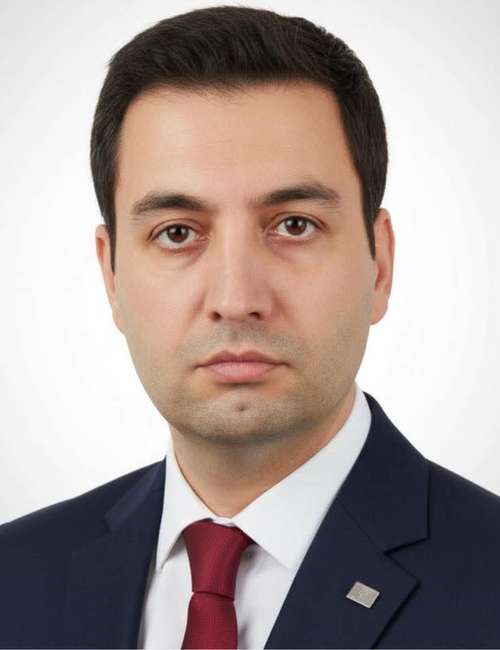
- Doctor of Philosophy Mathematics, University of Szeged, Bolyai Institute, Szeged, Hungary.
PhD in Lattice theory and its application (2022).
- Master of Science Mathematics ,University of Nottingham, Nottingham, United Kingdom.
MSc. in Number Theory (2013).
- Bachelor of Science in Mathematics, University of Duhok, Duhok, Kurdistan Region-Iraq.
BSc in Graph Theory (2009).
- Mohammad, D., Ahmed, D., & Salih, M. (2025). The elliptic Sombor energy of graphs. Communications in Combinatorics and Optimization. Advance online publication.
- Koran, M. M., Othman, S. A., & Ahmed, D. (2025). Estimating kappa distribution parameters: A comparative study of maximum likelihood and LQ-moment approaches. Statistics, Optimization & Information Computing, 14(1), 42–61.
- Ahmed, D., Salih, M., & Haje, D. (2024, August 18). Analyzing subuniverse counts in finite semilattices: Unveiling the rankings and descriptions. arXiv:2408.09595.
- Haje, D., Ahmed, D., Izanloo, H., & Saikia, M. (2024, July 9). The signed Roman domination number of ladder graphs, circular ladder graphs and their complements. arXiv:2407.07182.
- Ahmed, D., Horváth, E. K., & Németh, Z. (2023). The number of subuniverses, congruences, weak congruences of semilattices defined by trees. Order, 40(2), 335–348.
- Zaya, N. E., Haje, D., & Ahmed, D. (2023). The sixth and seventh largest number of subuniverses of finite lattices. Academic Journal of Nawroz University, 12(1), 143–148.
- Ahmed, D. (2022). On subuniverses of lattices and semilattices [Doctoral dissertation, University of Szeged]. PQDT-Global.
- Ahmed, D., & Czédli, G. (2021). (1+ 1+ 2)-generated lattices of quasiorders. Acta Scientiarum Mathematicarum, 87(3–4), 415–427.
- Ahmed, D., & Horváth, E. K. (2021). The first three largest numbers of subuniverses of semilattices. Miskolc Mathematical Notes, 22(2), 521–527.
- Ahmed, D., & Horváth, E. K. (2019). Yet two additional large numbers of subuniverses of finite lattices. Discussiones Mathematicae - General Algebra and Applications, 39(2), 251–261.
- Salih, M., & Ahmed, D. (2019, November 4). α-Q-fuzzy subgroups. arXiv:1911.04257.
- Abdullah, H. N., Ahmed, D. H., & Salih, M. M. (2018). Using Fibonacci number to integrate and matrices. Journal of University of Duhok, 21(1), 1–5.
- Ahmed, D., Czédli, G., & Horváth, E. K. (2018). Geometric constructibility of polygons lying on a circular arc. Mediterranean Journal of Mathematics, 15(3), Article 133.
- Ahmed, D. H., & Askar, N. A. (2018). Parallelize and analysis LU factorization and quadrant interlocking factorization algorithm in OpenMP. Journal of University of Duhok, 21(1), 46–53.
My research interests span several interconnected areas of pure and applied mathematics, with a particular focus on algebraic and ordered structures. Central to my work is the study of lattice theory and order theory, encompassing the structural analysis of lattices, partially ordered sets (posets), and their categorical and combinatorial properties, with applications extending to theoretical computer science, and formal logic.
My research interests span several interconnected areas of pure and applied mathematics, with a particular focus on algebraic and ordered structures. Central to my work is the study of lattice theory and order theory, encompassing the structural analysis of lattices, partially ordered sets (posets), and their categorical and combinatorial properties, with applications extending to theoretical computer science, and formal logic.My research interests span several interconnected areas of pure and applied mathematics, with a particular focus on algebraic and ordered structures. Central to my work is the study of lattice theory and order theory, encompassing the structural analysis of lattices, partially ordered sets (posets), and their categorical and combinatorial properties, with applications extending to theoretical computer science, and formal logic.
A further area of specialization lies in coding theory, where my interests are directed toward the construction and analysis of error-correcting codes, their algebraic foundations, and their role in reliable communication systems and information-theoretic security. This intersects with my work in group theory and number theory, in which I investigate algebraic symmetry, the arithmetic of prime structures, and the application of group-theoretic methods to modern cryptographic protocols and computational number theory.
In addition to these theoretical pursuits, I maintain a sustained research interest in mathematics education, with an emphasis on curriculum development, the cultivation of mathematical reasoning and problem-solving competencies, and the design of evidence-based pedagogical strategies for undergraduate and secondary mathematics instruction. My broader scholarly objective is to advance both the theoretical foundations of mathematics and the scientific study of its effective teaching and learning.
I have accumulated extensive teaching experience across several higher education institutions, including the University of Duhok, the University of Szeged, the American University of Kurdistan, and Newroz University. My undergraduate teaching portfolio encompasses a broad range of courses, including Lattice Theory, Discrete Mathematics, Number Theory, Differential Equations, Linear Algebra, Geometry, Optimization, Statistics, and Finite Mathematics.
My pedagogical approach is grounded in fostering critical thinking, analytical reasoning, and active engagement, with an emphasis on rendering abstract mathematical concepts accessible through the integration of theoretical instruction and applied problem-solving. In addition to course delivery, I have been responsible for designing syllabi, assessments, and instructional materials aligned with contemporary academic standards.
During my tenure as an assistant lecturer at the University of Szeged, I further developed competencies in course development, academic mentorship, and formative assessment. I have also contributed to curriculum review and program development initiatives to ensure academic rigor and alignment with current disciplinary standards. Furthermore, I have supervised undergraduate graduation projects, providing guidance in research methodology, academic writing, and scholarly ethics. These experiences have collectively reinforced my capacity for academic leadership, mentorship, and effective mathematical communication across diverse educational contexts.
My supervisory experience encompasses undergraduate and postgraduate research in pure and applied mathematics, with specialization in Lattice Theory, Order Theory, and Abstract Algebra.
At the undergraduate level, I have supervised projects on partially ordered sets, Boolean algebras, modular and distributive lattices, and foundational algebraic structures, with emphasis on formal proof techniques and abstract mathematical reasoning.
At the postgraduate level, supervision has extended to advanced topics including universal algebra, closure operators, fixed point theory, and applications of lattice-theoretic structures in mathematical logic and theoretical computer science. I have guided researchers in problem formulation, framework development, and the production of rigorous, original contributions.
My supervisory philosophy prioritizes analytical independence, critical inquiry, and the integration of abstract theory with interdisciplinary applications, thereby contributing to a sustained research culture within the department.
My academic activities reflect sustained engagement with international mathematical research, with a focus on lattice theory, universal algebra, geometry, and discrete mathematics. I have presented original research at several prestigious venues across Europe, contributing to scholarly discourse within the global mathematical community.
I participated in multiple editions of the Workshop on General Algebra (AAA), an internationally recognized conference series. My contributions include a talk entitled "(1 + 1 + 2)-generated lattices of quasiorders" at the 102nd AAA in Szeged, "Some large numbers of subuniverses of lattices and semilattices" at the 100th AAA in Kraków, and "Some large numbers of subuniverses of lattices" at the 99th AAA in Siena. These works addressed algebraic and combinatorial properties of lattice structures within the framework of universal algebra and order theory.
Additionally, I presented "Geometric constructibility of polygons lying on a circular arc" at both the 97th AAA in Vienna and the 5th Conference of PhD Students in Mathematics in Szeged, examining classical geometric problems through contemporary mathematical methods.
Through consistent participation in international conferences, I have contributed to current mathematical research, expanded my professional network, and engaged actively with the broader academic community.